

A THRESHOLD MOMENT
In 15 days ThriveSpan comes into the world.

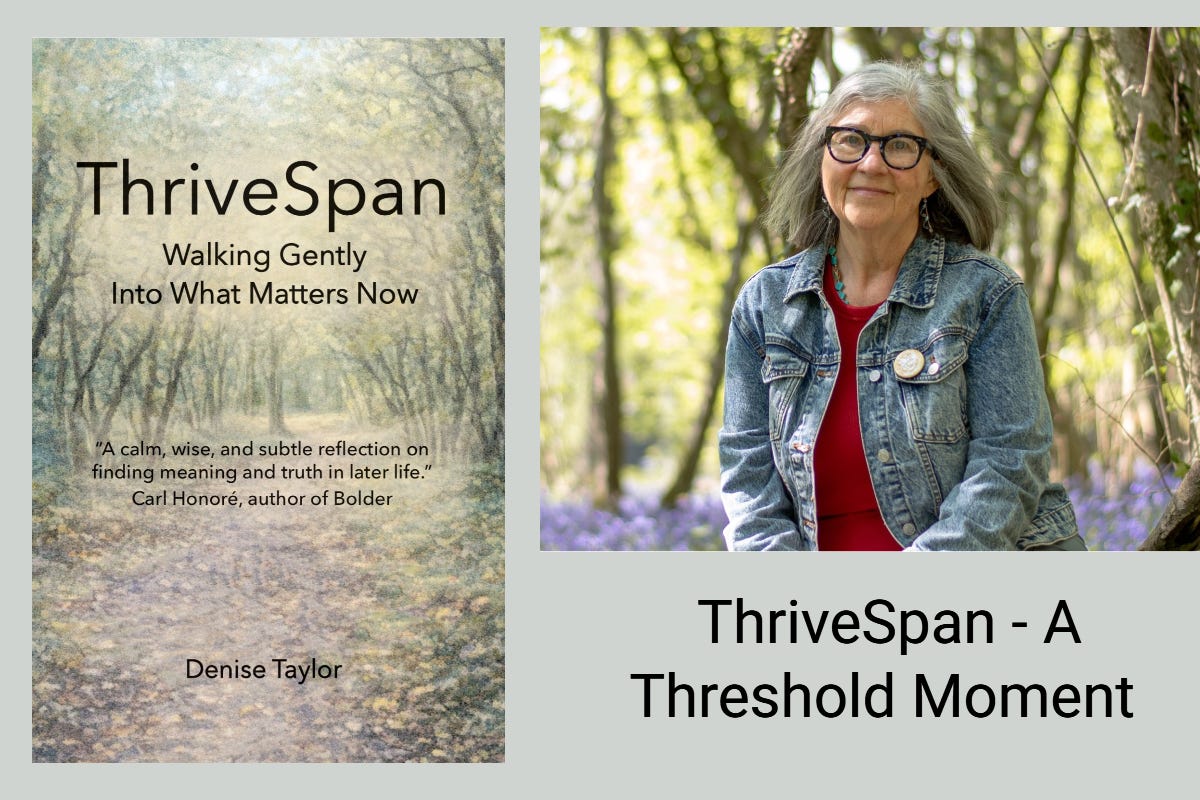
In 15 days ThriveSpan comes into the world. This weekend I’ve been reflecting on how it came to be.
There are moments when something ends, not because it has failed, but because it has done its work.
Looking back now, I can see that 2025 was that year for me.
For many years, I was known for writing and speaking about work in midlife, retirement transitions, and the long stretch between the two. I explored what it meant to stay engaged in your fifties, how people navigated leaving full-time work, and how identity reshapes itself when familiar structures begin to loosen.
That work mattered. It still does. It helped people make sense of a phase of life that is often poorly understood and thinly described.
I could have stayed there.
The topic remains popular. The market has expanded. There is no shortage of books, programmes, and voices focused on working longer, retiring better, or reimagining the second half of life. From the outside, it would have looked like a sensible place to remain.
But staying there would not have been moving forward for me.
When Staying Becomes Standing Still
What I began to notice, quietly at first, was that I was circling ground I already knew. I was answering questions I had largely finished asking. And while there is nothing wrong with deepening a field of expertise, I realised that repeating myself, however well-crafted the repetition, was slowly pulling me away from my own edge of inquiry.
This was not a sudden decision. It took time. It took sitting with uncertainty. And it took stepping away from noise.
Much of that reflection happened at my wood, away from professional agendas and expectations, with long stretches of quiet in which nothing needed to be explained, justified, or positioned. In that space, it became clear that the work I had been doing was complete in itself, and it was no longer where my thinking was heading.
Letting go of that identity was not easy. When you’ve spent years being recognised for something, when people know where to place you, walking away can feel unsettling. There is a particular discomfort in leaving a space just as it becomes more crowded. It can look, from the outside, as though you’ve been overtaken or edged out.
That wasn’t what was happening.
The Work That Was Always There
What many people don’t see is that the work I am now focused on did not suddenly emerge.
For at least seven years, well before I began my doctorate, I had been thinking about the whole span of later life, not simply the transition out of work. I was interested in how people live across decades as health, energy, priorities, and identity change, and how wellbeing, purpose, contribution, and meaning interact over time.
This was, in fact, the topic I originally wanted to pursue as my academic research. But it sat too far from the workplace to be taken forward within an occupational psychology department. As a result, my doctorate focused more narrowly on meaning after full-time work, an important and legitimate question, but not the full one I was carrying.
That broader inquiry never went away. It continued to develop through my doctoral research, through sustained academic reading, and through lived experience, my own and that of the people I worked with. Over time, it became clear that what I was developing was not simply a collection of ideas, but a coherent framework for understanding later life more fully.
That work has now taken shape as ThriveSpan.
From Retirement Thinking to ThriveSpan
ThriveSpan asks different questions. It is not primarily concerned with how we exit work, redesign careers, or remain productive for as long as possible, although those questions may sit within it. Instead, it looks at the whole arc of later life, including health, vitality, decline, rest, purpose, and contribution. It explores how our relationship to time changes, how energy becomes more precious, and how choices increasingly need to be aligned with what genuinely matters.
This is not another retirement book. And it is not a conscious ageing or spiritual manifesto either. Those spaces are already well populated. One tends to remain instrumental and work-focused, the other often idealised and detached from the realities of ageing bodies, finite energy, and lived complexity.
ThriveSpan sits somewhere else entirely. It is psychologically grounded, shaped by research, reflection, and experience, and attentive to both possibility and limitation. It does not offer prescriptions for how to age well, but a way of thinking about later life that is honest, humane, and responsive to change.
Crossing the Threshold
The decision to step away from retirement-focused work was not a reaction to competition, nor a loss of interest. It was a conscious choice to honour where my thinking had arrived, even though it took time to name it clearly.
Now my writing is shaped by ThriveSpan, by lifespan thinking, and by how we live honestly within the limits and possibilities of later life. This does not erase what came before. It honours it by allowing it to rest.
Thresholds are not always dramatic. Often they are quiet recognitions that something has reached its natural conclusion.
This was one of those moments.
What followed was not an ending, but a deepening.
The ideas that had been quietly developing over many years gradually found clearer form through research, writing, reflection, and lived experience. Earlier this year, that work became part of a published academic paper exploring the ThriveSpan framework for ages 60–80:
Reframing later life: The ThriveSpan framework for ages 60–80
https://nicecjournal.co.uk/index.php/nc/article/view/582
Further writing exploring ageing and later life is now also available as preprints, including:
Olderhood and Elderhood: Why Later Life Is Not a Single Developmental Stage
[LINK]
And On Ageing and Later life [LINK]
The inquiry continues. But it now feels rooted in a broader and more honest conversation about what it means to live well across the whole arc of later life.
In 15 days, ThriveSpan comes into the world.
If you’d like a sense of what the book is really about, I’m sharing the introduction and a chapter on joy with readers over the coming days.
You can receive them here if you’d like a preview of the book
ThriveSpan is not a guide to “successful ageing” or endless productivity. It’s a quieter exploration of what matters as we move through later life, and how we might live with more honesty, vitality, reflection, and meaning.
You may also like to return to an earlier article - Seven Years in the Making
PS
The Kindle edition of ThriveSpan is available to pre-order at £9.99, with the printed version (£16.99) following shortly.
I’ll also have a small number of signed copies available directly from me (£20 including UK postage).
And if you’re part of a group, book club, organisation, or community interested in a reading or conversation around later life, meaning, or ThriveSpan, feel free to get in touch.
There's something true about threshold moments — the ones you can name versus the ones that only reveal themselves six months later. Launching something new later in life carries a different weight. You're not building toward something that builds toward something else. You're here, now, and the thing needs to exist on its own terms. Best of luck with ThriveSpan — the work being done in this space matters. Writing about the lived side of these thresholds at theoldgreythinker.substack.com.
Enjoyed reading about your process of moving forward. Congratulations on Thrivespan. I look forward to reading more about it.