

The Beautiful Game
A football review

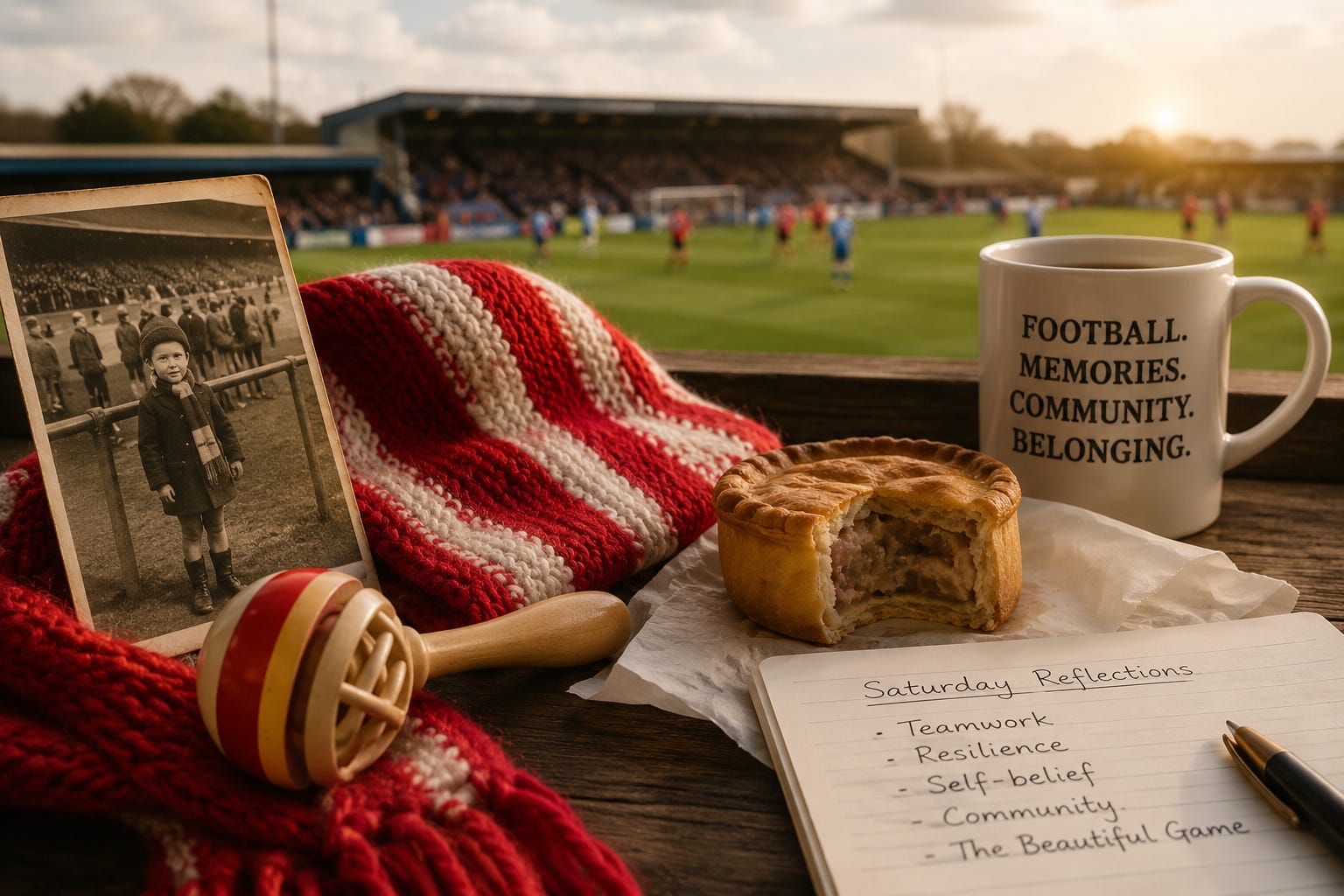
If you had asked me a few years ago whether I liked football, the answer would have been simple.
No.
I wasn’t interested in who was playing, who had won, who had lost, or where a team sat in the league table. Whether it was England, Manchester United or Cheltenham Town seemed completely irrelevant to me.
Part of that probably goes back to childhood.
My father used to take me to watch Witton Albion. I can still remember standing on the terraces, wrapped up against the cold, clutching a rattle and wearing a scarf. There would often be a pork pie involved somewhere along the way. It was part of family life rather than a passion of my own.
As soon as I was old enough to stop going, I did. For decades, football disappeared from my life. Then something unexpected happened.
Last year I watched Macclesfield play Crystal Palace. The underdog against the established team. Against the odds, Macclesfield won.
What stayed with me wasn’t the result itself. It was the feeling.
Watching that match took me straight back to those small football grounds from childhood. Not because I had been a passionate football fan. Quite the opposite. I went because my father took me.
Yet the memories came flooding back: the scarf, the rattle, the pork pie, the atmosphere of a local ground on a Saturday afternoon.
It was only later, reflecting on Macclesfield’s unexpected victory, that I found myself thinking about self-belief and the power of the underdog. Those weren’t thoughts I had as a child. They were meanings I discovered many years later.
This summer’s World Cup has drawn me in even further. I’ve watched England’s matches, of course. But I’ve also found myself watching games where I have no emotional investment in the outcome whatsoever.
Switzerland against Argentina. Belgium against the United States. Spain against France.
I’m not watching because I desperately want one side to win. I’m watching because I want to see a team in action. What fascinates me is not the individual stars but the way people work together.
I find myself noticing how players encourage one another after mistakes. How they celebrate each other’s successes. How quickly they regroup when things go wrong. How much trust is required to pass the ball to someone else and believe they will be where they need to be.
I watch the managers on the touchline. I watch the fans when the cameras sweep across the crowd. I watch the children in tears when their team is knocked out.
And I find myself thinking about discipline, preparation, resilience and self-belief.
When I studied psychology, sports psychology barely existed as a recognised field. At least, it wasn’t presented as a realistic career path. The choices seemed to be educational psychology, clinical psychology or occupational psychology.
I chose occupational psychology because I was already working in organisations and was fascinated by people at work. Sometimes I wonder whether I might have enjoyed sports psychology. Because what I find myself observing now is not just football. It is human behaviour under pressure.
Last night I watched Spain play France. I knew very little about either team beyond a few famous names. My assumption was that France would probably be stronger. Instead, Spain looked better almost from the beginning.
There was a fluidity to the way they played. The movement seemed more purposeful. The passing appeared more precise. They looked like a team that trusted one another. France, by contrast, seemed increasingly frustrated as the match progressed. Even Mbappé, one of the world’s biggest stars, appeared unable to find a way through.
I found myself less interested in the score and more interested in what happens when confidence rises or falls.
How does a team recover when things are not going to plan?
How do people respond when expectations are not being met?
Perhaps that is the occupational psychologist in me after all.
One of the surprises has been discovering how much I enjoy watching football simply for the quality of play.
A friend recently told me that if I enjoy these World Cup matches, I might also enjoy lower-league football. That idea would once have seemed ridiculous. Yet now I find myself wondering whether I should go and watch Cheltenham Town.
Not because I suddenly want to become a football fanatic. Not because I am planning to spend my weekends memorising league tables. But because football seems to offer something that many of us are searching for.
Community.
Belonging.
A shared story.
A reason to gather together with people we may otherwise never meet.
These are themes I write about often. They sit at the heart of ThriveSpan. As we move through later life, belonging becomes increasingly important. We need places where we feel connected to something larger than ourselves.
Perhaps football provides that for millions of people. Perhaps cricket and rugby do too. I honestly don’t know enough about either of them to say. What I do know is that football has surprised me. And perhaps that is the real lesson.
We often think we know who we are. We think we know what interests us. We think we know which chapters of our lives have already been written.
Then something unexpected happens. A match comes on television. A childhood memory stirs. A game we thought we disliked suddenly begins to reveal something beautiful.
As I write this on Wednesday morning, England’s next match is still to come.
My theatre group has already decided to skip the usual break and finish early so that everyone who wants to watch can get home in time. And I find myself genuinely looking forward to it. That sentence alone would have astonished the younger version of me.
Perhaps even more surprising is the memory that surfaced this week. I realised that I can still remember World Cup Willie from 1966. I remember the song. I remember the pictures. I remember the excitement.
I remember being a little girl living in Surrey before our family moved north to Cheshire to help care for my grandmother after she had a stroke. Those memories had been sitting quietly somewhere in the background for sixty years. And now, somehow, football has brought them back.
Who would have thought it?
If these articles resonate with you, you can support my writing with a paid subscription or by buying me a coffee using the link below. Your support gives me the time and space to keep exploring these questions.
And now it is Wednesday evening, and England are out.
To my surprise, I feel genuinely disappointed. A few months ago I would have struggled to name half the players. Now I find myself sharing the sadness that so many supporters are feeling.
Listening to the post-match discussion, much of the conversation focused on what England should have done differently. That is often our instinct after disappointment. We analyse mistakes. We look for what went wrong.
Yet one comment stayed with me. Joe Hart pointed out that before we criticise, we should remember how far this team has come. None of us has reached a World Cup semi-final.
That struck me because it applies far beyond football.
Whether it is sport, work, relationships or later life itself, we can become so focused on the outcome that we forget the journey. We notice what was not achieved rather than what was.
Perhaps that is another reason football has surprised me. I thought I was watching a game. What I seem to have been watching instead is human nature.
.
❤️”We need places where we feel connected to something larger than ourselves….meeting people we might not meet, bringing back memories” ✨✨✨
My family was an American football family and I liked the sport quite a bit as a I got older. I liked understanding the plays and strategies and the sometimes exquisite execution of teamwork, strength, and desire! Then I understood about concussions and lifetime disabilities, who gets recruited, who might get exploited. Now I miss, a little bit, going to to my alumni college games … what to do?