

When Did We Stop Having Fun?
Olderhood Unfolding 32

I found myself asking an unexpected question this week. Not about purpose. Not about healthy ageing. Not even about happiness.
About fun.
I had just finished watching a film in which the central character slowly rediscovers herself. She dances. She laughs. She lets herself be curious. She stops worrying so much about what other people think. As the credits rolled, I wasn’t thinking about the story. I was thinking about my own life.
Am I having enough fun?
It’s a surprisingly difficult question to answer.
We spend a great deal of time talking about purpose in later life. About staying active. About volunteering. About keeping our brains engaged. These things matter, and I’ve written about many of them myself.
But fun?
That often feels like an afterthought, almost something we have to justify. Yet I’m beginning to wonder whether we’ve underestimated its importance.
As I sat with the question, another one emerged.
Did I ever have much fun?
I was quite a serious child. I had a rich inner world and a vivid imagination, but I wasn’t the child who was always making everyone laugh or at the centre of the games. Looking back, I don’t feel deprived. I simply think I found enjoyment in different places.
Even as an adult, I’ve often been drawn to depth rather than lightness. I’d usually choose a meaningful conversation over a party, a walk over a crowded room, or an afternoon exploring an idea over almost anything else.
There is nothing wrong with that. In fact, those things have brought me enormous satisfaction.
But perhaps seriousness and playfulness are not opposites.
Perhaps we’ve made them opposites.
When I think about the moments that have felt most alive, they haven’t usually involved jokes or organised entertainment. They’ve been quieter than that.
Photographing jellyfish and losing track of time. Walking through the woods and suddenly noticing something I’d never seen before. A conversation where ideas bounce effortlessly between two people and time seems to disappear.
Trying something new simply because I’m curious to see what happens.
Maybe that’s what fun looks like for me.
The older I get, the more I think fun has less to do with what we’re doing and more to do with how we’re being. It arrives when we’re absorbed rather than performing. Curious rather than cautious. Present rather than self-conscious. Perhaps that’s why children appear to have so much fun. They are rarely wondering whether they look foolish. Somewhere along the way many of us become observers of our own lives instead of participants in them.
I’m not suggesting we all need to become louder, more extrovert or constantly in search of excitement. Playfulness has many forms. For one person it might be dancing until midnight. For another it might be trying watercolours for the first time, learning to paddleboard at seventy, or laughing over coffee with someone who makes the world feel lighter.
The important thing is not what fun looks like. It’s whether we’ve quietly allowed it to disappear.
So I’ve decided to keep asking myself a different question.
Not, Am I busy enough?
Not, Am I productive enough?
Not even, Am I living with purpose?
Those questions still matter. But alongside them, I want to remember another.
When did I last have fun?
And if the answer isn’t as recent as I’d like, perhaps the next question isn’t What should I achieve?
Perhaps it’s simply:
What might it be fun to do next?
As I sit with those questions, though, I wonder if I’ve defined fun too narrowly. I’ve imagined it has to be noisy or sociable or make us laugh out loud. But maybe fun is simply those moments when we stop doing what we ought to do and allow ourselves to enjoy what we’re doing instead.
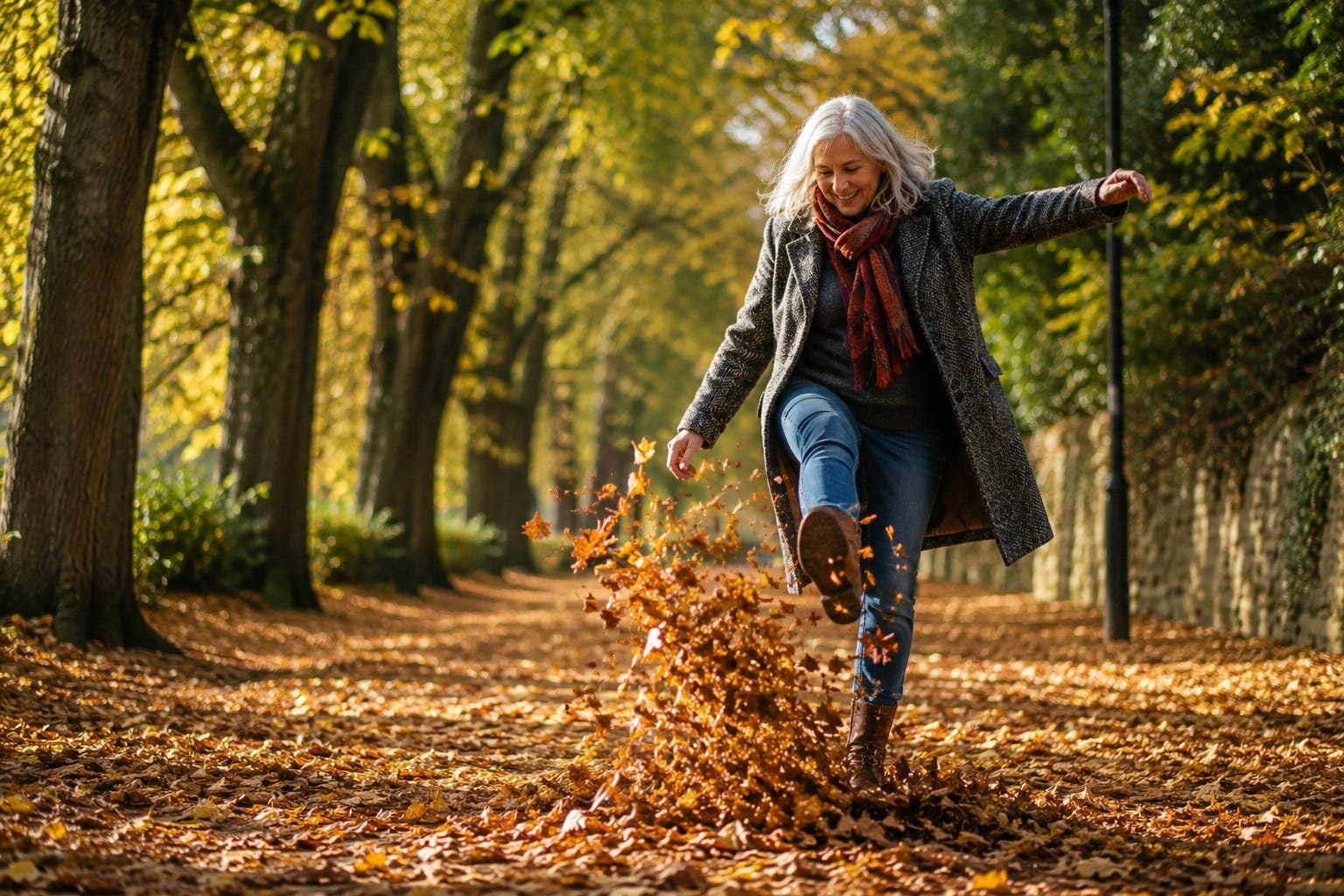
I always kick my way through piles of autumn leaves. I couldn’t tell you when I started, and I still couldn’t tell you why. I just know that every autumn, when I see them, I can’t resist. Perhaps that’s fun. And perhaps, rather than asking whether we’ve stopped having fun, we need to ask whether we’ve stopped recognising it.
.
Agreed. For me, there’s as much fun in a depth conversation with someone interesting, reading a great book or watercolour painting as there is in playing games or a sport. You’re right, we don’t have a broad enough definition for fun.
Such a powerful message Denise! It's so easy to slip into the trap of a comfortable routine and mistake 'being comfortable' for actually enjoying life. True fun usually takes a fair bit of friction and stepping out of the usual patterns and choosing to engage with enthusiasm. Thanks for shining a light on this; an essential message for oldies like me who love to just beaver away in the office.