

Why Some Reflection Sets Us Free
Olderhood Unfolding 28

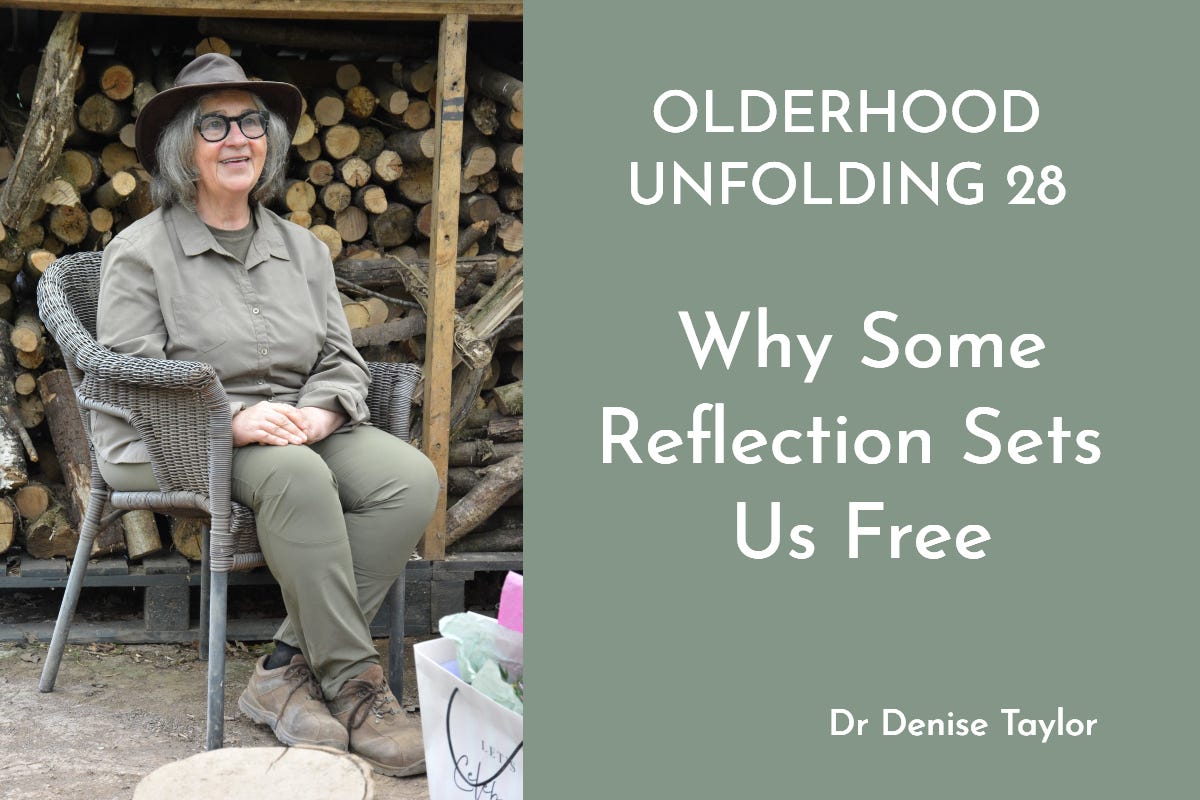
I’ve been thinking about introspection again. Not in the abstract, but in the way it actually shows up in life. In quiet moments. Sitting with a cup of tea. Walking. Being in the wood. Because I do a lot of it, and yet I’ve never felt it traps me in the way some people describe.
Recently, I came across a comment by Marc Andreessen, who said he aims to have as little introspection as possible. And I found myself understanding both sides. Because there is a kind of introspection that keeps people stuck. The kind that circles endlessly: why did I do that, why am I like this, what’s wrong with me. That kind of reflection can easily turn into a loop, a narrowing, a quiet form of self-criticism that never quite resolves. But that isn’t the only kind.
There is another kind of introspection, and it feels very different. It doesn’t begin with “why.” It begins with something simpler. What is happening here? What am I feeling right now? What is this asking of me? And sometimes, yes, it includes the past, but not in the way we often imagine. Not: I wish I’d done things differently. Not: if only that hadn’t happened. Because you can’t go back, and more than that, it’s rarely useful to try. Most of us made the best decisions we could with the information we had and the person we were at the time. Looking back through today’s eyes and judging yesterday’s self isn’t insight. It’s distortion.
For me, reflection tends to work differently. I might think about a past relationship or a decision I made, but the question isn’t “why did that happen?” It’s: what does that mean for me now? What do I see more clearly now that I couldn’t see then? What has shifted? The past becomes something to learn from, not something to return to.
Sitting in my woodland recently, I found myself thinking about a relationship from many years ago. Not because I wanted to revisit it, but because something about it suddenly made sense in a way it hadn’t before. The insight arrived quietly. Once it had arrived, there was nothing more to analyse.
There’s also something else I’ve noticed. Good introspection has a natural endpoint. You reflect, you understand something, even partially, and then it settles. You don’t keep going over it. You don’t need to. Life continues. In that sense, the purpose of introspection isn’t to stay inside your thoughts. It’s to allow you to step back into your life with a little more clarity.
Where it goes wrong is when reflection becomes a place you live. When every feeling needs analysing, every decision needs explaining, every past experience becomes a permanent reference point. That’s when it turns inward in a way that narrows life, rather than opening it. And yet the alternative, avoiding introspection altogether, doesn’t lead somewhere better. Because without some level of self-awareness, it’s easy to move through life repeating patterns without ever quite seeing them.
For me, the shift has been this: not less introspection, but a different relationship with it. Less digging, less explaining, less trying to “figure myself out.” And more noticing, more space, more trust that understanding comes in its own time and doesn’t need to be forced.
And perhaps that’s the quiet distinction. Introspection that deepens life versus introspection that traps it. One keeps you circling. The other helps you move forward, with a little more kindness towards yourself and a little more clarity about what matters now.
What I’ve come to see, especially in later life, is that introspection isn’t about perfect understanding. It’s about gentle orientation. A way of staying in relationship with your life as it is now, rather than getting lost in what has already passed. And that changes how reflection feels. It becomes less about explanation and more about recognition, less about the past and more about how you carry it.
In ThriveSpan, this sits quietly beneath much of the work. Not as a technique, not as something to “do well,” but as a way of walking through later life with awareness, without becoming absorbed by it. Because the aim is never to become endlessly self-reflective. It’s to reach a point where you understand yourself well enough that you no longer need to keep checking. Where reflection softens into presence. And life is simply lived from there.
Love it, love it, love it.